

09.09.2026
AI in Customer Service: Consumer Rights and Legal Risks
Who Is Liable When a Chatbot Gets It Wrong?
What happens when a chatbot provides incorrect information about a product, misleads consumers about their right to withdraw from a contract, or unlawfully personalises prices?
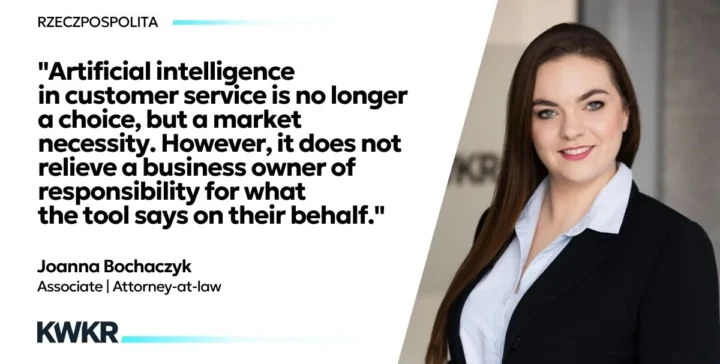
In an article published by Rzeczpospolita, Joanna Bochaczyk, Attorney-at-Law and Associate at KWKR, examines the legal implications of using artificial intelligence in customer communications and discusses where responsibility lies when AI-generated interactions affect consumer decisions.
AI Remains a Tool of the Business
Chatbots, voicebots and automated recommendation systems have become a common part of the customer journey. They assist consumers before purchase, during the transaction process and in post-sale communications, including order updates and complaint handling.
However, as generative AI systems become more sophisticated, they may produce responses that have not been anticipated or verified by the company using them.
As highlighted in the article, AI used in customer interactions remains a tool of the business. If a chatbot provides inaccurate information to a consumer, responsibility towards that consumer generally rests with the company that deployed the system, regardless of its relationship with the technology provider.
When Can a Chatbot Infringe Consumer Rights?
Legal risks may arise when AI systems provide misleading or inaccurate information regarding:
- pricing,
- product availability,
- key product features,
- delivery conditions,
- consumer rights.
Particular attention should be paid to information concerning the right of withdrawal from a distance contract. Incorrect deadlines, incomplete answers or communications discouraging consumers from exercising their statutory rights may lead to significant legal consequences.
The article also discusses risks associated with so-called dark patterns, including tactics that create artificial urgency, suggest negative consequences of abandoning a purchase, or discourage consumers from withdrawing from a contract.
Another area of concern is personalised pricing based on automated decision-making and the transparency obligations connected with such practices.
AI Transparency and the Regulatory Landscape
The analysis is set against the broader framework of consumer protection regulations, including rules on unfair commercial practices, the Digital Services Act and the AI Act.
The article also refers to the proposed Digital Fairness Act, which is expected to address issues such as AI-driven influence on consumer decision-making, personalised offers and pricing, and practices that exploit behavioural vulnerabilities.
As technology continues to evolve, businesses should closely monitor both existing and upcoming regulatory requirements affecting AI-enabled customer interactions.
Managing AI-Related Risks
Implementing AI in customer service should not end with deploying the technology itself.
The article identifies three practical measures that may help reduce legal risk:
- conducting regular audits of chatbots and voicebots,
- monitoring AI-generated customer communications,
- implementing procedures for handling complaints and correcting inaccurate information provided by AI systems.
Responsible use of artificial intelligence requires not only effective technology, but also ongoing oversight, reliable data and appropriate governance mechanisms.
