

17.07.2026
Safe Open Finance: DORA and FIDA Explained by KWKR Experts
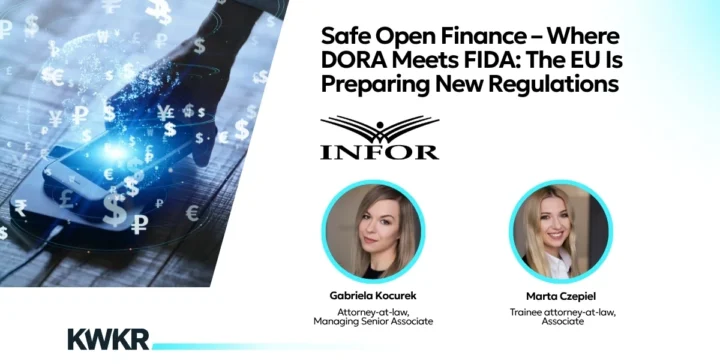
New publication by KWKR experts in INFOR.pl
Access to financial data and digital operational resilience have become two of the most significant regulatory topics shaping today’s financial services market. In their latest article published on INFOR.pl, Gabriela Kocurek, Managing Senior Associate, and Marta Czepiel, Associate at KWKR, examine the relationship between the DORA Regulation and the proposed FIDA Regulation, exploring how these frameworks may jointly influence the future of open finance in the European Union.
FIDA and DORA – Two Pillars of the Future Open Finance Ecosystem
The development of open finance is expected to facilitate broader use and sharing of financial data, enabling the creation of innovative products, services, and solutions for both consumers and businesses. At the same time, the growing importance of data brings increasing expectations regarding cybersecurity, operational resilience, and effective risk management.
As the authors explain, this is precisely where FIDA and DORA intersect. While FIDA is intended to establish a framework for secure access to and sharing of financial data, DORA focuses on strengthening the digital operational resilience of financial entities. Although each regulation addresses a different aspect of the financial ecosystem, their practical application is likely to be closely interconnected.
Digital Resilience as the Foundation of Data Sharing
One of the key themes discussed in the publication is the role of cybersecurity requirements in enabling a trusted and effective open finance environment. Wider access to financial data can only function successfully if accompanied by appropriate safeguards, robust ICT risk management processes, and effective incident response mechanisms.
The authors highlight that the proposed framework envisages a strong link between the obligations arising under FIDA and the resilience requirements established by DORA. As a result, entities participating in the future financial data-sharing ecosystem may be required to demonstrate a high level of digital operational resilience and compliance with relevant cybersecurity standards.
What Could the New Rules Mean for Market Participants?
The article also examines selected aspects of the future regulatory landscape for Financial Information Service Providers (FISPs) and discusses the current stage of the legislative process surrounding the FIDA proposal. These developments may be particularly relevant for financial institutions, fintech companies, and organisations closely monitoring emerging EU regulations concerning financial data, technology risk, and digital resilience.
The publication demonstrates that the success of open finance will depend not only on creating mechanisms for data access and sharing, but also on building trust in the system through strong cybersecurity practices and resilient digital infrastructure.
Read the Article
The full publication is available on INFOR.pl: Bezpieczne otwarte finanse – gdzie DORA spotyka FIDA? UE szykuje nowe przepisy – Infor.pl